


If your allergy symptoms seem to arrive at the same time every year, pollen could be part of the reason.
A new review of five years of South African pollen data is helping us understand which types of pollen are found across the country, when they are present and why this information matters for people living with allergic rhinitis and asthma.
The research, published in Current Allergy & Clinical Immunology, draws on data collected by the South African Pollen Monitoring Network (SAPNET) between 2019 and 2024. It provides the first five year national pollen calendars covering seven locations representing different South African climates and biomes: Cape Town, Durban, Gqeberha, Johannesburg, Bloemfontein, Pretoria and Kimberley.
Researchers identified 103 different pollen taxa, including 50 trees and 51 weeds.
Why does pollen matter?
Allergic rhinitis affects up to 40% of South Africans, and pollen is the most common outdoor aeroallergen. Symptoms can include sneezing, an itchy or blocked nose, a runny nose and itchy or watery eyes. For some people, pollen exposure can also aggravate asthma.
One important message from the research is that pollen exposure is not the same everywhere in South Africa.
The plants growing around you, the climate and the local environment all influence which pollens are present and when they occur. This means that pollen information from your own region may be much more useful than information from another country or even another part of South Africa.
Grass pollen: a major South African allergy trigger
Grass pollen was the most common type of pollen detected across all seven South African biomes.
One grass stands out in particular: Bermuda grass, also known locally as kweek grass. It is the leading individual grass allergen identified in South African studies.
In a Cape Town allergy cohort, 46% of patients tested were sensitised to grass, and 85% of those grass sensitised patients were sensitised to Bermuda grass. Similar findings have been reported in other parts of South Africa.
But “grass pollen” is not just one thing.
There are thousands of different grass species, and they can have different allergen profiles. The researchers highlight two broad groups known as C3 and C4 grasses. Bermuda grass is a C4 grass, while rye grass and some other temperate grasses are C3 grasses. C4 grasses are particularly important in warmer, summer rainfall regions of South Africa.
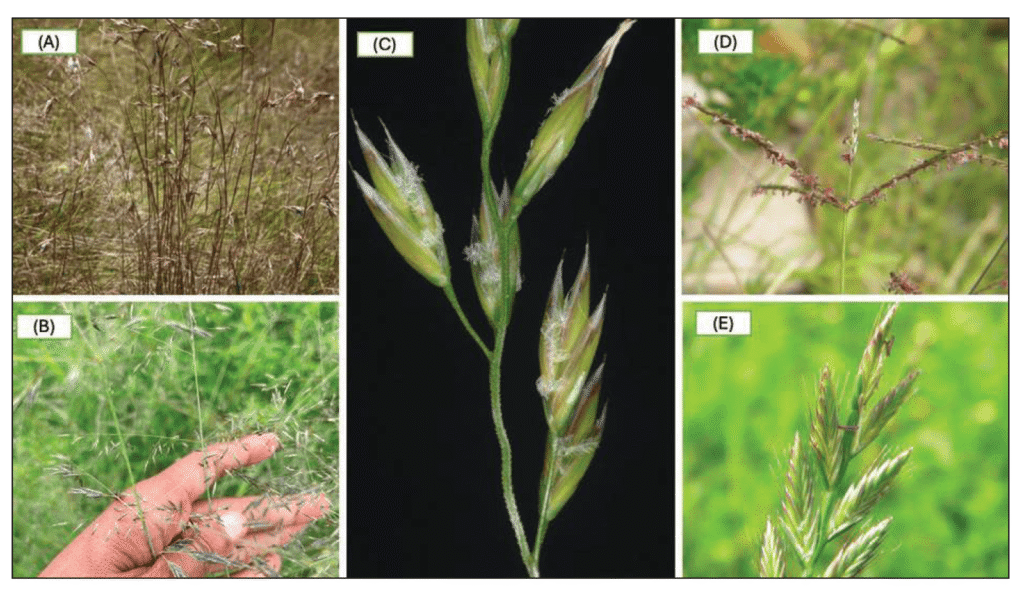
Figure 1: Different types of grass pollen relevant to South African allergy. This image shows examples of C3 and C4 grasses, including Bermuda or kweek grass, red grass, weeping lovegrass, tall fescue and perennial ryegrass. The distinction between C3 and C4 grasses is important because different grasses can have different allergen profiles and may respond differently to changes in climate. Figure adapted from Matuvhunye et al., 2026. Image credits and licences as provided in the original article.
For patients, the key message is simple: being allergic to “grass” does not necessarily mean every grass is equally relevant to your symptoms. Your healthcare professional can interpret your allergy testing together with your symptoms, location and exposure.
Tree pollen may be an overlooked trigger
The study also highlights the diversity of tree pollen across South Africa.
Tree pollen exposure generally peaks from late winter into early spring, which may be earlier than many people expect. In Cape Town, Johannesburg and Pretoria, trees such as eucalyptus, pine and cypress contribute significantly to the pollen load. Eucalyptus is also important in the coastal cities.
Inland areas have particularly diverse tree pollen exposure. The review highlights birch, mulberry, oak, Celtis and ash as potentially relevant allergens in Gauteng and the Free State, particularly for people whose allergic rhinitis persists despite standard allergy testing.
This does not mean that everyone with allergy symptoms needs extensive allergy testing. Rather, it highlights why your doctor may consider your location and exposure history when deciding which allergens to investigate.
Why can local pollen information help?
Knowing when particular pollens are present can help people with seasonal allergies understand their symptoms and prepare for periods when they are more likely to experience problems.
Pollen information may also help healthcare professionals decide when preventive treatment and allergen avoidance strategies could be most useful.
Importantly, the researchers stress that pollen monitoring data does not replace your individual medical history. The monitoring stations show which pollen is present in a particular region, but they cannot tell us exactly how much pollen an individual person has been exposed to.
Could changes in climate affect pollen seasons?
The review also considers what changing climate conditions could mean for pollen allergies in the future.
Changes in temperature, rainfall and atmospheric carbon dioxide may influence how plants grow, how much pollen they produce and when pollen seasons occur.
The researchers note that tree pollen seasons could potentially begin earlier as temperatures increase, while some weed pollen seasons could extend further into winter. They also highlight ragweed as a potential future concern in parts of South Africa where it is not currently established.
Research from other parts of the world suggests that changes in climate may contribute to longer pollen seasons or higher pollen concentrations, although the authors caution that the direct impact on health outcomes in South Africa still requires further study.
What can you do if pollen triggers your allergies?
Start by paying attention to when your symptoms occur.
Do they appear at the same time every year? Are they worse when you spend time outdoors? Do they coincide with certain seasons or particular locations?
Keeping a simple symptom diary can provide useful information to discuss with your doctor or allergy specialist.
You can also follow the South African Pollen Monitoring Network’s regularly updated information at www.pollencount.co.za, where weekly pollen counts and city specific pollen calendars are available.
And remember, a positive allergy test is not the whole story. Your symptoms, medical history, environment, timing of exposure and appropriate allergy testing all need to be considered together.
The bigger picture
For the first time, South Africa has five years of detailed pollen monitoring across several of its major climatic regions. This gives healthcare professionals and patients a much clearer picture of the pollen landscape around us.
For people living with pollen related allergies, knowledge can help you prepare. Understanding which pollens may be present in your area, when levels are likely to increase and how your symptoms relate to the seasons can help you have a more informed conversation with your healthcare professional.
Pollen is part of our natural environment, but for people with allergies, knowing what is in the air can make a real difference.
References: Matuvhunye T, Berman DM, Esterhuizen N, Razafimanantsoa AHI, et al. Five years of national airborne pollen monitoring in South Africa: biome specific calendars to inform allergy diagnosis and prevention. Aerobiologia. 2026;42:23. doi:10.1007/s10453-026-09909-w. It was published online on 15 April 2026.
Matuvhunye T, Razafimanantsoa AHI, Makunyane MS, Upton CM, Hansrajh V, Berman DM, Peter J. Five years of South African pollen data: How can this help your allergy practice? Current Allergy & Clinical Immunology. 2026;39(3):160–167.
Figure 1: Poaceae: understanding the clinical significance of C3 and C4 grasses under a changing climate. Representative grass species relevant to aerobiological exposure, classified by photosynthetic pathway. A) Themeda triandra (red grass; C4), B) Eragrostis curvula (weeping lovegrass; C4), C) Festuca arundinacea (tall fescue; C3), D) Cynodon dactylon (Bermuda or kweek grass; C4), E) Lolium perenne (perennial ryegrass; C3). Image credits and licences as stated in the original publication.
For more information on Pollen Allergy see here>>


0 Comments